


Barcelona attractions - what to see the most interesting places, photos
Barcelona is one of the most beautiful and oldest cities in Europe, famous worldwide for its attractions. This city is famous for its industrial development, a large port and magnificent architectural masterpieces that attract thousands of curious tourists every year. If you are here for the first time, what is worth seeing in Barcelona? We have prepared for you a list of the most exciting places in this amazing city.
What to see in Barcelona first
When you are familiar with the most exciting places in Barcelona, the services of guides may seem superfluous, but when visiting the city for the first time, it is better to use the experience of professionals. They will help you see the resort from a new perspective, revealing unexpected aspects, and will leave you with nothing but pleasure from every moment of your stay in the city where the great Gaudi worked.
The Expiatory Temple of the Sagrada Familia

The Temple of the Sagrada Familia is one of the most remarkable historical buildings in Barcelona and is included in the list of the best attractions in Spain. This temple attracts the attention of all tourist guides who recommend visiting it in Barcelona. It would be unforgivable to miss this place.
The cathedral was created by the great architect Antonio Gaudi, although the original idea was developed by Francisco del Villar.
Every day the temple is open to the public, and guests can participate in religious services or simply admire the architectural splendor. Many tourists do not miss the opportunity to take a photo in front of this majestic building. Some come here specifically to personally see the magnificence of the famous architect's work.
Casa Mila

The last civil engineering project that Gaudi worked on is the landmark Casa Mila. Its construction took several years - from 1906 to 1910.
The Casa Mila house is distinguished by many innovative ideas that were implemented during its construction. One of the most striking is the design of the building. Gaudi expressed the opinion that this house could easily be turned into a hotel due to its successful layout.
A special ventilation system was developed for the house, and a private garage was also provided. Currently, visitors can notice elevators in the house, although they were not originally included in the project. They were added several years after the completion of construction.
Park Guell

Park Güell is considered one of the most beautiful places in Spain. It is located at Carrer d’Olot, 5, and is a notable landmark of Barcelona. Initially, this project was conceived as a commercial one, but did not receive due recognition, as a result, it was transformed into an amazing place where everyone can enjoy the privacy and beauty of nature, away from the bustle of the city.
Walking through the park, visitors can enjoy an amazing combination of living nature and human craftsmanship. In front of the entrance there are two magnificent houses designed by the talented architect Gaudi. On one of them you can see a small tower with a cross, and the second house, although large in size, is not always associated with the work of Gaudi, since this is an unusual direction for him.
Casa Batlló

Travelers wondering what to see in Barcelona should not miss Casa Batlló. This unique architectural monument is known for its lack of straight lines. The courtyard is especially impressive, the lighting of which creates a unique atmosphere. At sunset, the house is transformed, acquiring the silhouette of a huge dragon, which adds to its fabulousness.
Casa Batlló is located in the Quarter of Dissent, which is famous for its many unique buildings considered true masterpieces of architecture.
Palace of Catalan Music
The Palace of Catalan Music was included in the list of "Patrimonies of Humanity" by UNESCO leaders. This landmark of Barcelona was created by the talented architect Lluís Domènech, whose works continue to amaze the imagination. The palace became one of Domenech's most successful works.
The location of this wonderful place is near the Gothic Quarter, where tourists go who know what is worth seeing in Barcelona. The building attracts attention with its white stucco and coral-colored walls, becoming a symbol of Catalan architecture and music.
The architecture of this building contains elements of postmodernism. Graceful sculptures complementing the stucco patterns delight travelers.
Camp Nou Stadium

The New Field remains the largest stadium in Europe to this day. This symbol of Barcelona is known to many. Many historical matches between great sports clubs have taken place at Camp Nou.
This stadium is not just included in the list of city attractions. It is famous not only for its football pitch. Camp Nou also offers a sports hall where volleyball, handball and basketball teams train, as well as a leisure centre and a museum.
The Nou Field Museum opened its doors in 1984 and is considered the most visited place in Catalonia, where significant exhibits are collected. Many consider it the best football museum. Fan club members can visit this museum for free and enjoy its exhibits.
Bocqueria Market or Sant Josep

If you are going to Barcelona and do not know what to see, be sure to visit the Boqueria Market. This is the most famous and diverse market square in the city, which is mentioned in documents as early as 1237. The original food market was located near the walls of the old town and attracted farmers and peasants from all over the region who came here to sell their goods.
In 1914, the decision was made to modernize the market, and a metal roof was added, which significantly improved its appearance. Even today, you can meet vendors on Boqueria whose families were engaged in trade here in the very first years of this legendary market.
Cathedral of the Holy Cross and Saint Eulalia

This majestic cathedral plays a key role in the architectural heritage of Barcelona and occupies an important place among the many historical monuments in the Gothic Quarter. The idea to build this building arose under King Jaume II, and construction began in 1298. The construction process took almost 150 years, mainly due to the long period of military conflicts and epidemics that swept the country.
The cathedral, dedicated to the Holy Cross and Saint Eulalia, the patron saint of the city, is not only a symbol of religious faith, but also of cultural heritage. Its crypt still contains a sarcophagus with the relics of the saint.
Park of the Ciutadella or Park of the Ciutadella

The park was organized on the site of a former military citadel, destroyed in 1869. Then a large park was created on this site, adapted for the needs of the World Exhibition, held in 1888.
Today in the Park of the Ciutadella you can still see the remains of the past exhibition, including the buildings located on its territory. Tourists can enjoy views of the Castle of the Three Dragons, as well as visit the restaurant, lake and waterfall. However, many visitors to the park prefer to stroll through the shady garden and explore the greenhouse.
On one side of the park is the Zoo, which occupies the territory of the former parade ground of the military citadel.
Spanish Village (Architectural Museum of Catalonia)

Travelers who have not yet decided what exactly to see in Barcelona can spend time in the Spanish Village. This is a city of artisans and craftsmen that has turned into a huge museum that is open to anyone who wants to immerse themselves in the local architecture.
This museum has various bars, restaurants and shopping pavilions. Interesting exhibitions and concerts are often held here. The Spanish village offers visitors copies of almost all the famous architectural masterpieces typical of Spain.
Interestingly, this attraction is located right in the center of a modern metropolis. To fully explore the village and study each exhibit, travelers will need a lot of time.
Barcelona Attractions: What Else to Visit While in Barcelona
For those interested in excursions in Barcelona, we offer several additional places that are definitely worth visiting. You won't get bored in this city, because around every corner you'll find a new museum, cathedral, gallery, square with sculptures and much more.
Plaza Espanya in Barcelona

The grandiose square, recognized as one of the most majestic in the city, was conceived and designed back in 1929 for an international exhibition. At that time, the Art Nouveau style was not particularly popular, and so the architect had to resort to a classical style with Baroque elements. This combination gave Barcelona its charm and captivated the visitors of the exhibition center.
The Plaza de España, included in the lists of recommendations on what to see in Barcelona, is a kind of gateway to the exhibition. In its center is a huge fountain decorated with sculptures. At that time, the square was a red brick building that served as a hotel, and on the other side there was a bullring. Nowadays, this place has turned into a shopping center.
Tibidabo Amusement Park

Tibidabo Mountain towers over the city, representing the place where an impressive amusement park is located. The idea of creating this unique attraction belongs to Dr. Salvador Andreu, after whom even the square where one of the stations of the funicular leading to the mountain is located is named.
The park opened in 1901 and even then offered a wide range of entertainment, including a funhouse, bowling, pigeon post, slot machines and much more. These various attractions have been appreciated by both locals and tourists from all over the world.
The Barcelona amusement park also has its own hotel, where everyone can stay.
Science Museum (CosmoCaixa)
.jpg)
The Science Museum in Barcelona is no less exciting than its unique exhibits. The construction of this remarkable building was done in the modernist style, and more than 100 million euros were spent on its construction.
The Science Museum offers its visitors a wide range of exciting activities. Its halls feature both temporary and permanent exhibitions designed to introduce people to the amazing world of science.
The peculiarity of this museum is that visitors have the opportunity to freely touch the exhibits with their hands. In addition, they are given the chance to participate in interesting experiments in the fields of geology, technology, mathematics and chemistry.
Columbus Monument

A crowd of people always gather around this iconic place in Barcelona. It is almost impossible for tourists to pass by the 57-meter statue depicting the famous explorer Columbus. It was erected immediately before the Universal Exhibition held in 1888.
The idea of creating such a monument first arose in the mid-19th century, but its implementation was unsuccessful. The project was revived several times, only to fall into oblivion again. However, work on the monument eventually began. The funds collected through donations were used for construction, and part of the city budget was allocated for this purpose.
Royal Square

Each tourist decides what to visit in Barcelona first, based on their preferences. However, one of the attractions that is worth seeing is the Royal Square. Its elegance is emphasized by lanterns, live palm trees and a fountain, and in the evening it acquires a special charm, attracting more visitors.
Around the Royal Square there are various buildings, made in the classical style. In the past, these were the homes of influential families, and now they are a haven for representatives of modern bohemia. Here you can find luxurious restaurants, fashionable boutiques and nightclubs, making this place even more attractive.
Arc de Triomphe

A list of the best Barcelona attractions would not be complete without the Arc de Triomf. This architectural masterpiece was erected specifically for the International Exhibition, which gave the event even more significance and grandeur. It became the main entrance to the territory of the exhibition held in 1888.
Located at the intersection of two boulevards of the city - Passeig de San Juan and Passeig de Lluis Companus, the Arc de Triomf was built in the neo-Moorish style.
The arch is made of red brick, which significantly distinguishes it from other similar structures that are landmarks of Moscow and Paris. It is decorated with many original sculptures and bas-reliefs.
La Rambla

If you only have a few days to explore Barcelona, you should start with the most significant places in the city. What sights to visit in Barcelona in 5 days? One of the first places to see is La Rambla - the most popular promenade in the city, dividing the Raval and Gothic districts. This place is never empty: there are always many tourists and locals, artists perform on the street, vendors offer souvenirs, and a festive atmosphere is in the air. On La Rambla you can find everything: souvenir shops, cozy cafes, street musicians and artists. La Rambla is divided into 5 sections: Canaletes, Teachings, where the university was once located, Flowers with many flower shops, Capuchins with a theater, Santa Monica with a cultural center and the recently built Rambla del Mar with a picturesque pedestrian bridge.
Pedralbes Monastery

Pedralbes Monastery is located in the quarter of the same name, which is famous for its sophistication in Barcelona. Here modern buildings coexist with ancient mansions, creating a unique architectural ensemble. This mix of styles and eras gives the area its own unique charm. Around the monastery there is a beautiful park, giving the place a special atmosphere.
The monastery always amazes with its magnificence. Most of its buildings were built in the 14th century, adhering to the Catalan Gothic style. One of the most outstanding elements of the monastery is its cell, which many consider a real work of art. It is decorated with picturesque paintings made by the court master Ferré Bassa.
A visit to Barcelona is an opportunity to see unique architectural masterpieces that cannot be found anywhere else. This ancient Spanish city attracts visitors from all over the world with its unique attractions.
Agbar Tower

The Anbar Tower, built in 2005, is a modern landmark that stands out from the general architectural appearance of Barcelona with its unusual shapes and height. This building, resembling a huge cigar in shape, becomes a unique decoration of the city and an excellent landmark for tourists. The view of the tower is amazing: more than 4 thousand LED lights built into colored glass panels turn the skyscraper into a magnificent light show, playing with millions of shades, like a precious stone. However, this unusual cladding is not just a decoration - it also has a practical meaning: the panels, moving like blinds, react to temperature readings, providing optimal ventilation and energy saving inside the building.
Gothic Quarter

The Gothic Quarter in Barcelona got its name from the abundance of Gothic buildings that are located within it. This place is impossible to ignore - its historical architecture amazes with its beauty and uniqueness. Long before our era, this area was an ancient Roman city with fortified walls, aqueducts, temples, baths and a forum. The existing buildings visible today were built in the 14th century, and since then the development of the quarter has remained virtually unchanged, which has allowed to preserve the atmosphere of the Middle Ages in their original form. The northern part of the quarter is famous for the old cafe "Four Cats", which was a favorite place of Pablo Picasso. The most outstanding architectural masterpieces of the area include the majestic Cathedral and the Baroque Bishop's Palace.
Plaza Catalunya

When choosing what to see in Barcelona in a week, you cannot ignore Plaza Catalunya - one of the most attractive places in the city, from where many famous tourist routes begin. This is the place where life is in full swing and the heart of the city beats - rallies and festivals are held here, including the Festival of Our Lady of Grace, which is considered one of the most significant for locals. Despite the huge area of more than 50 thousand square meters, it always feels crowded, as both tourists and locals come here to meet each other. In the center of the square there is a fountain consisting of two sections and surrounded by sculptures. Among the notable buildings in the square are the Canadian consulate, bank branches and the central tourist information office.
Picasso Museum

Travelers going to Barcelona in winter are often interested in how to spend time this season. In the city itself, the air temperature in winter is around +15 degrees, which makes it a great place for active recreation. However, if the weather is not conducive to walking, an entertaining tour of museums can be a great alternative. One of the most famous is the Picasso Museum, which presents an extensive collection of the artist's works. The exhibition mainly consists of his early works, created in the early 20th century, although there are also several works from the mature period, including the "Las Meninas" series. The total number of exhibits in the museum reaches about 3.5 thousand. The museum itself is located in an old palace of the 19th century, which creates a special atmosphere for immersion in the world of art.
Church of Santa Maria del Mar

In the 14th century, one of the bright symbols of Catalonia's prosperity was the church of Santa Maria del Mar, a Catalan Gothic temple that still amazes with its grandeur. This temple was built with the money of ordinary people in honor of Saint Mary, the patroness of sailors. Its task was to surpass the Barcelona Cathedral in beauty and grandeur. Unlike the latter, Santa Maria del Mar was intended for ordinary people - merchants, artisans, loaders. This building amazes with its sophistication: beautiful stained glass windows, wide arches, a Gothic rose window, graceful sculptures, including figures of Jesus Christ, the Virgin Mary, John the Baptist, the apostles Peter and Paul. These sculptures, still preserved, seem to have life.
National Art Museum of Catalonia

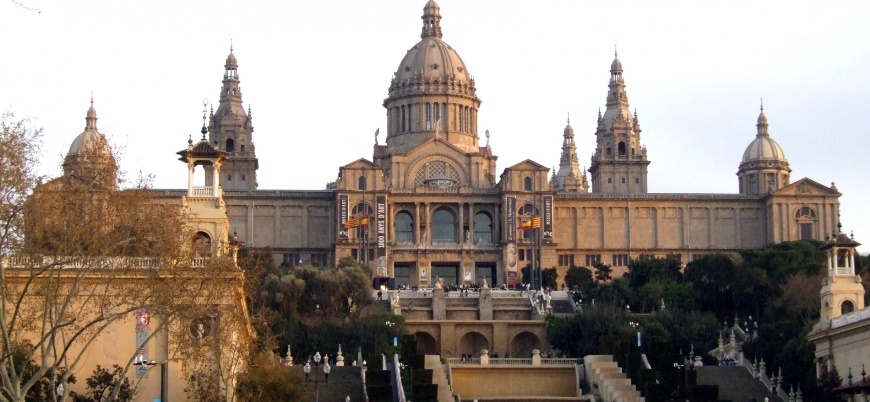
Along the Gran Via Avenue, one notices a huge building surrounded by fountains and greenery, located on a hill. This is the National Art Museum of Catalonia, one of the leading centers of Romanesque art in the world. In addition to works from the Romanesque period, it also houses masterpieces of Gothic art. Romanesque art flourished from the 11th to the 13th centuries and is largely preserved in the old churches of the Iberian Peninsula. The museum began its history with the opening of the Romanesque section, which presents paintings and murals from early Catalonia. The Gothic section contains works of art from the 13th to 15th centuries, and the Flemish collection of art from the 16th to 18th centuries represents the Renaissance and Baroque. Contemporary art is reflected in the works of the 19th and 20th centuries.
Temple of the Sacred Heart

The face of Barcelona architecture is the Temple of the Holy Family, which adorns the highest point of Barcelona - Mount Tibidabo. For many centuries, Tibidabo remained distant and inaccessible to most people. However, the Catholic committee decided to use these lands to build a great temple, emphasizing its sacred purpose. At first, in 1886, a small chapel was built, and then the patron San Juan Bosco, following the popular tradition of building temples of the Sacred Heart of Jesus around the world, decided to build a similar temple here. By 1961, a majestic temple had been built, which to this day amazes with its magnificence and monumentality, Gothic architecture, and the statue of Jesus Christ, seemingly ascending from the top of the temple straight to heaven. A tiny chapel, which became the forerunner of this basilica, is modestly located to the right of the main entrance.
Montjuic Fortress

Montjuic is a mysterious fortress that has witnessed many military events in the history of Spain. It is located on the mountain of the same name, towering over the old city of Barcelona. Until the 17th century, there was only a watchtower on this site, but in the middle of that century, the Iberians erected an impressive fortress structure in a matter of weeks. Many fierce battles were fought here, including with Napoleon's army. Initially built in haste, the fortress, intended for temporary use, has survived the centuries thanks to constant reconstruction and strengthening. In the 20th century, it even served as a military prison for political prisoners, and has now been transformed into a military museum, where exhibits of medieval weapons, military uniforms, maps, medals, coins and much more are presented.
Montserrat Monastery

Many tourists choose Barcelona to enjoy its architectural masterpieces. Antonio Gaudi, an outstanding Spanish architect, left an indescribable mark on the architectural culture of the city. In the capital of Catalonia, he implemented dozens of projects, among which the Montserrat Monastery stands out, a symbol of the spirituality of Catalonia, located at the foot of the mountain of the same name. Not only Gaudi but also many other talented artists worked on the creation of this monastery, adding various stylistic elements with a predominance of modernism to the work. The altar is made of local stone, the throne of the Madonna is made of silver, and the biblical history of the universe is depicted on the plates inside the chapel. Of particular interest is the altar chapel, which shows the characteristic features of Gaudi's work. However, the Black Madonna is of greatest value to pilgrims - a small statue of the Virgin Mary, 95 centimeters high, carved from black poplar.
Barcelona Aquarium

In addition to famous places and popular monuments, Barcelona has other, less obvious, but no less amazing attractions that are of interest to tourists. One of these places is the Barcelona Aquarium - the largest among European aquariums, containing about 6 million liters of water and more than 11 thousand marine inhabitants from 450 species. There are 14 pools here, inhabited by animals from different climatic zones of the planet. Each pool is a model of a certain aquatic environment: from the sea depths to freshwater rivers and salt lakes, from coral caves to other underwater landscapes. The main attraction is a huge oceanarium with a long tunnel that allows visitors to dive into the sea world by passing under its bottom. For younger guests, a special educational zone has been created, where they can feel like explorers of the sea.
Magic Fountain of Montjuic

When exploring the sights of Barcelona on foot, it is worth climbing the slopes of Montjuic Hill, where Carles Buïgas Square is located with one of the greatest decorations of the city - the Montjuic Fountain, which is one of the symbols of Barcelona. The fountain has an oval shape, in the center of which there are several cascades. Locals often call this fountain "singing" because in the evening it is transformed, and the jets of water begin to dance to the music of Bach, Beethoven, Tchaikovsky, as well as modern melodies. The beginning of this exciting performance is always accompanied by the famous composition "Barcelona", performed by Freddie Mercury in a duet with Montserrat Caballe. Thousands of spectators gather at the viewing platforms and in the surrounding restaurants to enjoy this breathtaking spectacle.
Barceloneta Beach

The name Barceloneta is not only a coastal area of the city, but also a magnificent public beach with well-developed infrastructure, which has become a favorite vacation spot for both locals and tourists. In the morning hours, you can see active lifestyle enthusiasts running along the beach, and in the evening, there are often performances by musical groups and street artists, various events and concerts are organized. The beach consists exclusively of sand, has a convenient entry into the water, is equipped with showers and sun loungers, and also provides beach equipment rental services. There are special areas with attractions for children, and for a variety of recreation and snacks, you can visit one of the many cafes and restaurants in the immediate vicinity. Tourists wishing to stay near the beach can choose one of the hotels in this area on the website of the travel agency TurPoisk.
